A friendship circle for paper people · free to join · run by UB3BIJ
The 88 Paper Club
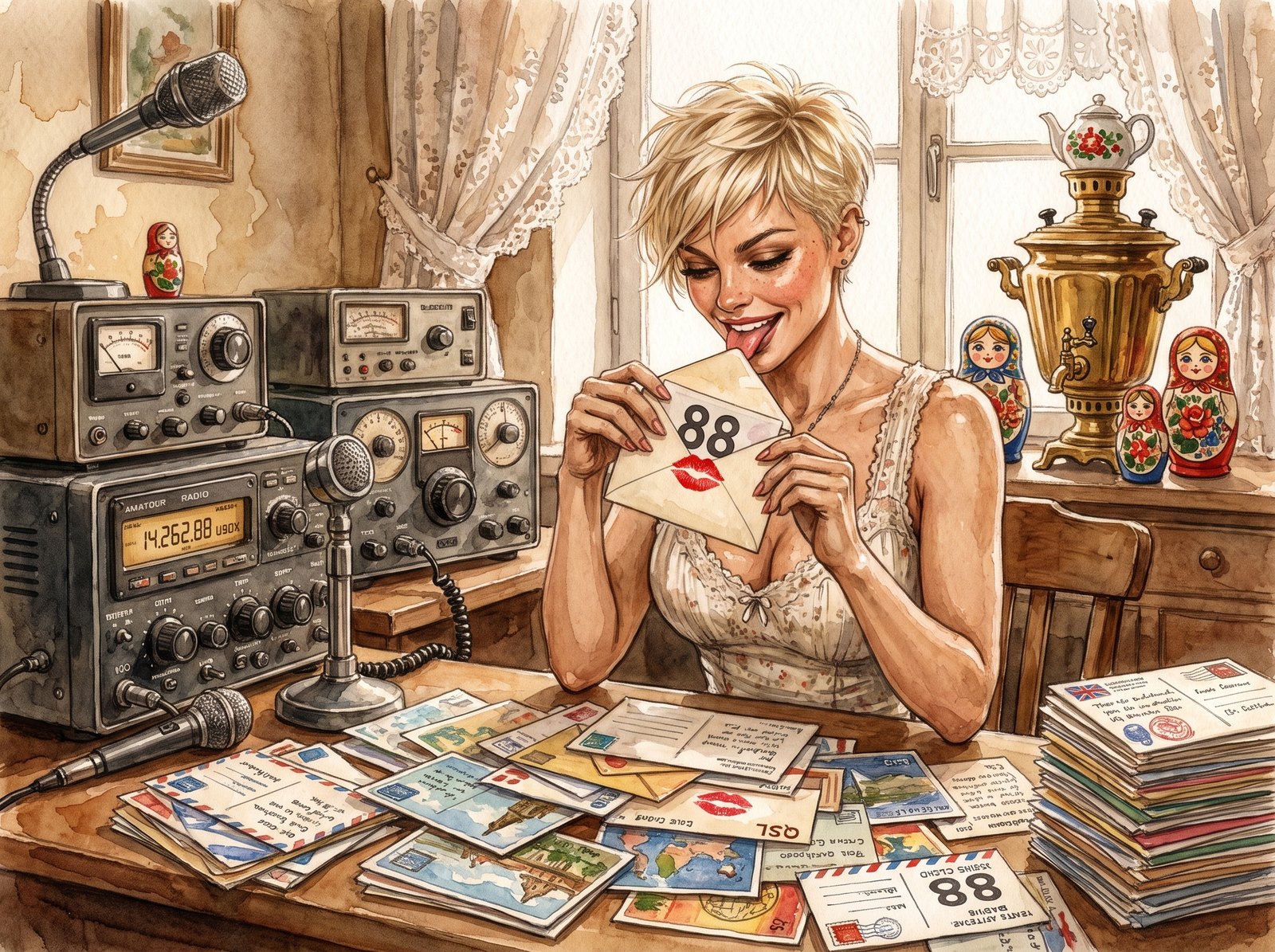
In radio talk, 88 means love and kisses. We mean it on paper. A club for everyone who thinks a QSL card is not a database row — it is a little letter from a stranger who heard you exist.
Join the club → Member entrance
yes, actually free. no exams. bring stamps ♥
What this is (and what it is not)
Hi! I'm Iskra, UB3BIJ, and I have a confession: I have five thousand printed QSL cards and, on five watts from a Moscow rooftop, approximately nobody to send them to. And I refuse — refuse — to let five thousand pieces of beautiful paper die in a box.
So this club is for people like me. People who run QRP and log three contacts a month, all from the next town over. People whose cards are gorgeous and lonely. People who open the mailbox hoping for cardboard. Collectors, doodlers, letter-writers, paper romantics of every country and every licence class.
We send each other our cards as gifts. Not as contest evidence. Not for awards. A card from the savanna lands in a Moscow letterbox; a card from Moscow flies to New Zealand; somebody in America gets a hand-drawn heart from Europe. That's it. That's the whole club — well, that and a mission we take genuinely seriously.
a card is a tiny museum
that fits in an envelope
Why this exists (the serious part, said unseriously)
Underneath the kisses, this club has an actual mission, and I want it in writing where everyone can see it:
We are preserving the culture of the paper QSL card — one of the loveliest traditions the radio community ever invented — before it quietly fades away.
For about a century, operators have confirmed contacts with printed cards. Millions of them crossed borders through wars and thaws: little rectangles of cardboard with callsigns, hand-inked reports, photographs of home towns and homemade antennas. Shack walls papered with them are museums nobody planned. Every card is a primary document: this person, this place, this signal, this exact night — somebody heard somebody.
The internet confirms contacts in milliseconds now, and that's fine, that's progress, I use it too. But a database row has no handwriting. Nobody ever pinned an ADIF file to a wall. So while the world speeds up, this club slows one small thing down, on purpose: we keep printing, writing, drawing hearts, licking stamps, and building collections worth keeping.
The promise of this club
No card sent through the 88 Paper Club ends up in the bin. Cards get kept, collected, treasured, passed on. Collections of operators who have gone silent key deserve to be inherited and cared for, not cleared out — if you ever hold one, the club will help it find loving hands.
And I'll go first: when I become a silent key, my entire collection is bequeathed to a museum. Every card you send me is, technically, already a future museum piece. No pressure — but do use your good handwriting.
your card will outlive the internet ♥
So this is for the collectors, the archivists, the romantics, and everyone who suspects that "a technology of the past" and "a treasure" are frequently the same thing. One friendly, open, free circle — anyone, anywhere, welcome — swapping cards, swapping countries, swapping a little proof that strangers can be kind to each other across nine time zones.
How it works
Five steps, in order, like a good postal route.
- 1
Write me one letter
Callsign, name, country, how cards can reach you (bureau or direct), and whether you want the monthly on-air meetup. The button above pre-writes it for you. I answer with a welcome letter, the house rules, and your personal password to the members page.
- 2
Meet the roster
Behind the member door lives the list: callsigns, countries, e-mails, and who accepts what. E-mails are for saying hello and making friends. Postal addresses are never published — you swap those personally, when you both want to.
- 3
Get your monthly round
Once a month I mail every member a small list of 3–5 clubmates to send a card to, matched so the geography crosses the planet. That way everyone gets mail, not just the loud ones. Want more? Ask me. You want 5 addresses, you get 5. You want 105 — darling, you get 105.
- 4
Work the monthly net
Once a month we all meet on the air — same day, same frequency, everybody works everybody, honest 59s all round. Real contacts, real logs. Which means the cards that follow are real QSL cards, and the bureau carries them exactly as bureaus were born to do.
- 5
Send paper, get paper
Cards travel mainly via the bureau between members; direct mail is a private agreement between two people who chose it. And the golden rule of the whole club: a card received is a card answered. Somebody spent a stamp on you — spend one back.
What to write on the card
This is the heart of it. A club card is not a filled-in table — it's a tiny letter. On the front or back, in any language plus a little English:
- your name, not just the callsign
- a greeting and a good wish — real ones, not boilerplate
- a line about your town, your weather, your antenna, your cat
- a hand-drawn something — heart, sun, cucumber, anything
- your e-mail, if you'd like a pen-pal back
If the card follows our monthly net — fill the QSO table honestly, it was a real contact. If it's a pure gift card outside the net, leave the QSO table empty and mark it clearly:
NO QSO · NOT FOR AWARDS
JUST 88
…and then a heart,
and your name ♥
That one honest line keeps the whole thing clean: nobody's award programme is confused, nobody's log is muddled, no bureau volunteer frowns. It is a gift and it says so, proudly.
my prettiest cards go out first.
send me your prettiest too — I'm collecting!
The monthly net
One session a month. Date, band and frequency go out to members by e-mail a week ahead (conditions decide the band; my five watts get a vote). We gather, we call, everybody works everybody, we all give proper cheerful 59s, and for one hour the band belongs to paper people.
Can't make it? Completely fine. The net is a treat, not a duty — gift cards and the monthly rounds don't depend on it. QRP, big guns, SWLs who just listen and write in: all welcome.
// first net: date announced to members — join and you'll get the letter
House rules (short, like a good QSO)
- Cards are gifts. Gift cards say so on the card. Net cards are real QSLs.
- We send to members only — everyone here asked for mail.
- A card received is a card answered. Take your time, but answer.
- Kindness only. No politics, no lectures, no grumpy DX-cluster energy.
- E-mails stay inside the club. Postal addresses are traded personally.
- Leaving? One letter to me and you're out, data deleted, no hard feelings.
Questions people actually ask
What even is a QSL card?
A postcard-sized confirmation of a radio contact. "QSL" is old radio shorthand for "I confirm reception". For roughly a century, when two operators worked each other, they mailed cards: callsign, date, time, frequency, signal report — plus whatever beauty the sender could print or draw. Collecting them is as old as the hobby itself, and a wall of QSL cards is the traditional wallpaper of a proper radio shack.
Why paper, when the internet confirms contacts instantly?
For the same reason people still write letters, press flowers, and print photographs. Electronic QSL is efficient and I use it — but it confirms a contact without commemorating it. Paper has handwriting, postmarks, a journey, a smell of post office. It turns "we exchanged 59" into "a person across the planet made something and sent it to me". Efficiency is not the only thing worth optimising for.
Who can join?
Any licensed amateur anywhere on Earth — any country, any licence class, any power. Shortwave listeners (SWLs) are warmly welcome too: SWL cards are a proud old tradition of their own. If you love paper, you belong. The club is international, the working language is English plus goodwill, and every other language is welcome on the cards themselves.
Does it cost anything?
Membership — nothing, ever. Your only costs are your own cards and your own stamps. Bureau delivery usually comes with membership of your national amateur society; direct mail costs whatever your post office charges. There is no premium tier. The premium tier is drawing a better heart.
Do club cards count for awards like DXCC?
Cards from our monthly net — yes: those follow real logged contacts and are ordinary, fully honest QSL cards. Pure gift cards sent outside the net — no, and they say so right on the card ("FRIENDSHIP · NO QSO · NOT FOR AWARDS"). That single honest line is what keeps this club sweet instead of shady. We don't fake contacts. We don't need to — we have stamps.
Is this official? Who runs it?
Gloriously unofficial. It's an independent open initiative run by me, Iskra (UB3BIJ), from a Moscow rooftop, with no committee, no fees and no gatekeeping. It's open-source in spirit too: the rules are public, and if you want to run a sister circle in your own country or language — please do, and tell me, and our members will send your members mail. Spreading the culture is the whole point; nobody owns a love of paper.
What happens to all these cards in the long run?
They become history — on purpose. Cards are kept and collected, never binned. Collections of silent keys deserve inheritance, not a skip; if one ever comes to you, the club will help it find a home. Mine is already promised to a museum. Somewhere in the future there's a display case of early-21st-century QSL cards, and the card you mail this month might be in it, heart doodle and all.
I don't have printed cards. Can I still join?
Absolutely. Print a small batch — it's cheaper than you fear — or make them by hand. Hand-made cards are not the budget option here; they are the luxury option, and members fight over them. A card drawn in a notebook with a real pen beats a glossy print with no soul, every single time.
Join us
One letter. That's the whole entrance exam. Send it to:
Club address
II@ub3bij.ru
Open in mail app …or just copy the address above and write from wherever you like.
Don't know what to write? Copy this.
Hi Iskra! I want to join the 88 Paper Club.

Callsign:
Name:
Country & town:
Cards can reach me via:   bureau / direct  (keep one)
I want the monthly on-air meetup:   yes / no
A line about me:

73 & 88!
Subject line, if your mail app asks: 88 Paper Club. Fill in what you can — I'll ask about the rest when I write back with your welcome letter and members password.
I read everything. I answer everything.
73 & 88 — Iskra